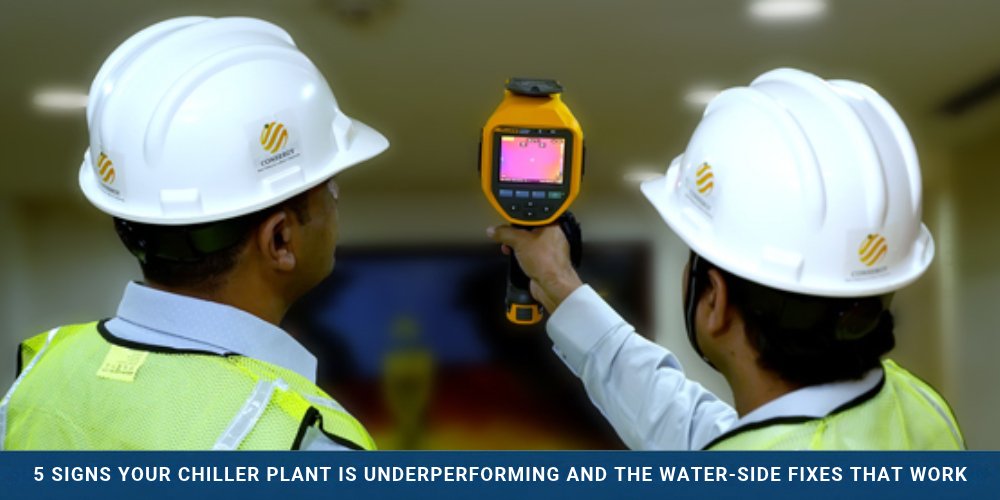
Direct Answer: Your chiller plant is likely underperforming if you see rising energy bills without increased load, frequent high-pressure trips, a growing condenser approach temperature, visible scale or biofilm in tubes, and excessive water bleed-off. These symptoms point to water-side inefficiencies that HVAC water-side optimization can resolve without equipment replacement.
Why Does Water-Side Health Determine Chiller Performance?
Chillers transfer heat through metal tubes. When scale, biofilm, or corrosion products coat those surfaces, heat transfer degrades. Even a 1mm scale layer can increase energy consumption by 10% to 15% because the compressor must work harder to achieve the same cooling output.
Traditional HVAC water treatment services often rely on chemical dosing alone, which manages symptoms but does not fully restore thermal conductivity or prevent deposit adhesion on the hottest surfaces.
The 5 Warning Signs of an Underperforming Chiller Plant
Sign 1: Condenser Approach Temperature Is Rising
What is condenser approach temperature? It is the difference between the refrigerant condensing temperature and the leaving condenser water temperature. A clean condenser typically holds a stable approach. When this gap widens, fouling is insulating the tubes. This forces higher head pressure and increased compressor lift, directly inflating kWh per ton of cooling.
Sign 2: Energy Bills Climb Without a Load Increase
If your facility’s cooling demand is flat but power draw is trending upward, the water side is the prime suspect. Scale acts as a thermal resistor. The compressor compensates by running longer and at higher pressure ratios. Industrial HVAC efficiency solutions target this exact penalty by restoring heat transfer rather than adding mechanical capacity.
Sign 3: Frequent High-Pressure or High-Temperature Trips
When condenser tubes foul, the chiller cannot reject heat efficiently. The system approaches safety limits and trips to protect the compressor. Operators sometimes reset the alarm and continue running, which accelerates wear. An industrial HVAC system audit can measure approach temperatures and flow rates to confirm whether fouling or flow imbalance is the root cause.
Sign 4: Visible Scale, Biofilm, or Corrosion in Tubes
Scale appears as a hard, chalky deposit on hot surfaces. Biofilm feels slick and traps suspended solids, creating under-deposit corrosion. Both conditions reduce flow and heat transfer. Traditional chemical programs may slow new formation but often fail to remove existing deposits that already penalize efficiency.
Sign 5: Excessive Water Wastage and Bleed-Off
To control scaling, plants often increase blowdown, wasting water and treatment chemicals. This is a false economy. Pushing cycles of concentration without matched antiscalant control simply concentrates hardness further. Sustainable cooling in water-stressed regions like Pune requires breaking this cycle with precise, chemical-free or targeted treatment.
Comparison: Symptoms vs. Water-Side Fixes
| Warning Sign | Underlying Water-Side Cause | Effective Fix |
| High condenser approach | Scale or biofilm insulating tubes | Chemical-free conditioning or nanofluid enhancement |
| Rising energy per ton | Reduced heat transfer efficiency | Restore thermal conductivity of chilled water |
| High-pressure trips | Inefficient heat rejection | Eliminate scale and biofouling at the source |
| Visible deposits | Mineral precipitation and microbial growth | Non-chemical treatment that prevents adhesion |
| Water wastage | Excessive blowdown to control scale | Optimized cycles with scale-control technology |
How Do Water-Side Fixes Work Without Replacing Equipment?
Modern HVAC water-side optimization uses targeted technologies to restore performance inside existing pipes and tubes. Consergy’s approach, delivered through authorized partners like QPoint Engineering Solutions, combines two distinct methods:
- Maxwell® is a patented nanofluid added directly to chilled water loops. It improves the thermal conductivity of the water itself, enabling faster heat transfer through existing chiller bundles without downtime or mechanical retrofits.
- DeCaIon™ is a chemical-free system for condenser water. It eliminates scale, biofouling, and corrosion without the salt discharge or chemical handling associated with traditional softening.
Together, these technologies address both the chilled water and condenser water sides of the plant. The result is measurable energy savings, stable approach temperatures, and reduced water consumption – without the capital expense of chiller replacement.
Step-by-Step: Implementing a Water-Side Optimization Program
- Conduct a baseline industrial HVAC system audit. Record approach temperatures, kW/ton, flow rates, and water chemistry under stable load. Without a baseline, savings cannot be verified.
- Inspect tubes and water quality. Check for scale thickness, biofilm, and corrosion indicators. Review current blowdown practices and cycles of concentration.
- Select the appropriate water-side technology. Chilled water loops benefit from thermal conductivity enhancement. Condenser loops require scale and biofouling prevention.
- Install without production interruption. External clamps or direct injection methods avoid pipe cutting and system shutdown.
- Monitor and verify. Track approach temperature and energy consumption monthly. A sustained reduction confirms the fix is working.
Frequently Asked Questions
How quickly can water-side fixes reduce energy costs?
Most facilities see measurable improvement in condenser approach temperature within weeks of treatment, with corresponding energy reductions appearing in the first full billing cycle after stabilization.
Do these solutions replace traditional HVAC water treatment services?
They complement or replace chemical-heavy programs. Chemical-free conditioning eliminates scale adhesion without the brine discharge and handling risks of salt softeners. Some facilities still use minimal biocide for specific biological control, but the heavy chemical burden drops significantly.
What makes Pune facilities particularly suited to this approach?
Pune’s industrial water supply is often hard, with high calcium and magnesium content. Scale formation is aggressive. Water scarcity also makes blowdown waste costly. Chemical-free conditioning and thermal enhancement address both the hardness problem and the water conservation imperative.
Is an equipment replacement ever necessary?
Only if tubes are physically damaged or the compressor has reached end of life. In most underperforming plants, the metal is intact – it is the water side that has degraded. Restoring heat transfer recovers the majority of lost efficiency at a fraction of replacement cost.
Take the First Step Toward Lower Costs
Rising energy bills and unstable chiller performance rarely mean you need new equipment. They mean your water side needs expert attention.
QPoint Engineering Solutions, an authorized partner of Consergy, delivers industrial HVAC efficiency solutions and HVAC water treatment services across Pune and India.
Contact us at +91 8605010543 or support@qpointsolutions.com to schedule your industrial HVAC system audit and stop paying for inefficiency.